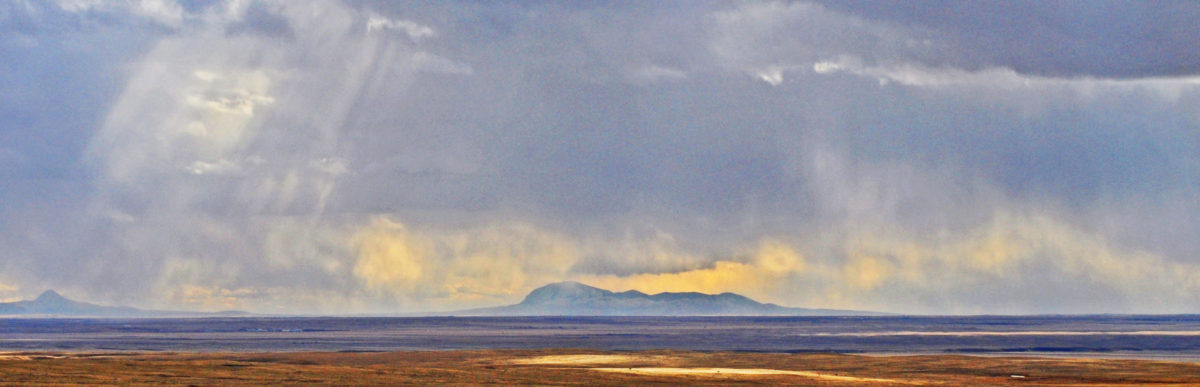
a prediction

Week 40 John

John the Baptist…
Each one of the gospel writers mentions him. Some of them say more about him than others. Some give details that others skip. But there’s a unanimous point they all make – John the Baptist was the material realization of a prophecy Isaiah had forecast more than four-hundred years before.
I flipped back to Isaiah and looked at the passage that Matthew Mark Luke and John all agree went from fuzzy long-range forecast to rock-solid reality on the day John the Baptist began publicly teaching. Isaiah told Israel to expect to hear a voice saying: make a highway for the Lord through the wilderness. Make a straight, smooth road through the desert for our God. Fill the valleys and level the hills. Straighten out the curves and smooth of the rough spots. Then the glory of the Lord will be revealed, and all people will see it together.
Matthew Mark & Luke say that John was The Voice that Isaiah was talking about. But in John’s gospel John the Baptist says it for himself…
Are you the Messiah? No!
Are you Elijah? No!
Are you the Prophet? No!
Q: then who are you? A: John replied in the words of Isaiah “I am a voice shouting in the wilderness, prepare a straight pathway for the Lord’s coming”. The wait is over.

Note: quotes from Isaiah 40:3-5 & John 1:23 (NLT). And see Isaiah references in Matthew 3:3, Mark 1:2 and Luke 3:4.

the Word

Week 40 John

John begins his gospel talking about The Word: in the beginning was the Word.
It sounds at first like The Word is something non-personal. But right away John adds that: the Word was with God, and the Word was God.
So The Word isn’t a thing. John says: he (The Word) was with God in the beginning.
If The Word was in the beginning with God it sounds like he was different than God.
But The Word was God – which sounds like he was the same as God.
So The Word and God were the same and also different.
Hmmmm… John adds a couple more things about The Word:
Through him all things were made
In him was life, and that life was the light of men
He was in the world…(but) the world did not recognize him
The Word became flesh and lived for a while among us.
It’s only when John gets to verse 17 that the to-this-point-unidentified Word is given a name: Jesus Christ. So that helps.
John adds one more detail: no one has ever seen God, but God the only Son…has made him known. The Word was different than God – there was God the Son & God the Father – and that elemental difference meant that the Son (who visibly & materially became flesh-and-blood) could disclose the Father (who was immaterial and invisible).

Note: quotes from John 1:1, 3, 4, 10, 14, 18 (NIV)

the fourth gospel

Week 39 John

Each of the gospels tells the story of the Lord Jesus.
Different writers. Different ideas. Different points-of-view. Different objectives. It makes common sense that they’d be a bit different. If they were all the same I’d only need one. In spite of their differences it’s surprising to me that Matthew Mark Luke are as similar as they are. And then comes John.
John is different. Different enough that if I was on a flight to Mars and I could only take two gospels John would have to be one of them (for me it would be John & Luke. But whatever…one would have to be John).
John seems to think along different lines than the other three. Not on a completely different wavelength, and not to say the first three gospels aren’t unique. But I think MM&L are unique and similar. John has taken the less-travelled road. Sure…he has the same hero with the same awesome talents and the same fateful finale followed by the same oh-man-what-a-relief! revival. But all along the way there’s subtlety and novelty and singularity and originality.
Three songs written in a major key and then the fourth in a minor.
Three guys shooting baskets at one end of the court…the fourth one making free-throws alone at the other.
John’s gospel story is a great one. But I know I’m in the deep end of the pool right from the start.

near the end

Week 39 Luke

At the beginning of September I started tracking place-names in the gospels. And reading through Luke during the last ten days I saw quite a few places named: Nazareth Bethlehem Jerusalem the Jordan Galilee Capernaum Nain the Gerasenes Bethsaida.
But that was at first. Once I got past chapter nine I began noticing that place-names quit showing up. The end of the chapter said: as the time approached for him to be taken up to heaven, Jesus resolutely set out for Jerusalem. When that last journey began I didn’t spot any geographic markers in chapters ten eleven twelve thirteen fourteen fifteen or sixteen (in the middle of that section it said that the Lord: went through the towns and villages, teaching as he made his way to Jerusalem. And a bit later: on his way to Jerusalem, Jesus travelled along the border between Samaria and Galilee). But I only got reoriented when the Lord arrived in Jericho & Bethphage & Bethany and then finally ended his trip at the end of chapter nineteen –the temple in Jerusalem.
The Lord’s last journey from Galilee to Jerusalem took about ten chapters. Roughly 425-verses – about 37% of the book – were devoted to the days it took to travel that 100 kilometer stretch of road.
Luke was by far most interested in that long trip up to Jerusalem during those last weeks of the Lord’s life on earth.

Note: quotes from Luke 9:51, 13:22, 17:11 (NIV). End of September reading progress: I finished Luke yesterday so I’m 85% done.

who is he?

Week 38 Luke

There’s a short paragraph in chapter nine where king Herod sits thinking: so who is this man about whom I hear such strange stories? It’s not like Herod had absolutely no idea who the Lord was. He’d heard rumours: when report of Jesus’ miracles reached Herod Antipas, he was worried and puzzled because some were saying, “This is John the Baptist come back to life again.” Others were saying, “It is Elijah or some other ancient prophet risen from the dead.”
Personally I’m not super-interested in what Herod was thinking but I did pick up a kind of reverb just nine verses later. The Lord is alone with his disciples and he asks them: Who do people say I am? “Well,” they replied, “some say John the Baptist, some say Elijah, and others say you are one of the other ancient prophets risen from the dead.”
So what’s the line on the Lord?
Is he John the Baptist?
Elijah?
Another prophet?
Herod’s wondering. People are wondering. The disciples are wondering. But when the Lord asks the twelve the light suddenly goes on for Peter as he realizes: you are the Messiah sent from God.
Popular guesswork had elevated the Lord to a Very Special Status. But it turns out that the VSS designation was selling him short. John or Elijah or Isaiah-or-Jeremiah-or-Ezekiel-or-Daniel were all special but not special enough. Not even close.

Note: quotes from Luke 9:9, 7-8, 18-19, 20 (NLT)

king of the castle

Week 38 Luke

Matthew Mark & Luke all mention the Temptation of Christ.
In that story the Devil says something that’s pretty interesting. It’s during the second temptation when that weird almost semi-visionary & anti-gravity event occurs: the Devil took (Jesus) up and revealed to him all the kingdoms of the world in a moment of time. It seems fantastical – an extraordinary display of brute power. Then the Devil says that if the Lord will worship him he – the Devil – will turn over the kingdoms of the world to him – the Lord. What caught my attention was what the Devil said next: I will give you the glory of the kingdoms and authority over them – because they are mine to give to anyone I please.
That’s a dramatic claim: they are mine to give to anyone I please!
I know the Devil isn’t hand-cuffed by having to tell the truth so the claim might be a lie. But the Lord doesn’t challenge him on it (I know that doesn’t mean that it isn’t a lie but I’m surprised the Lord totally disregards the kingdoms-are-mine claim).
Anyway what concerns me most is that if it actually is true – that the Devil really does have authority and a kind of ownership over the nations of the world – then what?
Well…for starters it complicates things for everyone living on earth. And personally & specifically it complicates things for me living here in Medicine Hat Alberta.

Note: quotes from Luke 4:5, 6 (NLT)

two takes

Week 38 Luke

Right away you notice the difference between them.
Mark starts like this: here begins the Good News about Jesus the Messiah, the Son of God. Then he devotes seven verses to John the Baptist. A total of five to Jesus’ baptism and temptation. And six verses on disciple-selection. By verse 21 the Lord’s ministry has begun.
Luke is more patient. He tells the long back-story of John’s miraculous conception and the long back-story of Jesus’ even more miraculous conception. Then the birth of John and the birth of Jesus.
Luke’s also interested in John’s early life: John grew up and became strong in spirit. Then he lived out in the wilderness until he began his public ministry. And he’s interested in Jesus’ early life too: so Jesus grew both in height and in wisdom, and he was loved by God and by all who knew him. It takes Luke 183 verses to do what Mark does in 21.
Mark’s account has drive and energy and action and it blasts-right-through from one thing to the next – a kind of Life of Jesus in bullet-points. Luke is different. Thoughtful deliberate careful; an orderly narration of events.
I don’t think Mark wrote his gospel in a bus on the way to work. And I don’t think Luke sat in a library researching his material. But if I found out they did I wouldn’t be surprised.

Note: quotes from Mark 1:1, Luke 1:80, 2:52 (NLT)

personal preparedness

Week 38 Mark

The Lord predicted the demolition of the biggest building in Jerusalem. It was hard to believe and Peter James John & Andrew asked the Lord when it would happen. Jesus’ answer turned into a forecast of his own return to earth at the end of days.
I got a sheet of paper to make a list of the clues. I found a dozen of them and that many hints gave me a feeling of being in the driver’s seat for forecasting the end of times. But some of the clues are a bit fuzzy. For example a lot of wars are going to precede the end of days – it’s an ok clue but not a decisive one. I wondered what would be decisive? Well, something like The Year 2048AD would be. But Mark doesn’t get anywhere near that degree of specificity.
One definitive clue Mark gives is that stars will fall. Mark says when that happens: everyone will see the Son of man arrive on the clouds. The only downside is that a forecast like that isn’t really a before-cast. It sounds like an actual part of the Lord’s reappearance.
The most decisive things I see in the chapter aren’t forecasts. They’re personal notifications:
Don’t be misled
Watch out
Endure
Pay attention
Don’t be fooled
Stay alert
Keep a sharp lookout
In the end the chapter sounds more like a Personal Preparedness Inventory and less like a Future-Events Checklist.

Note: quotes from Mark 13:26 & 5, 9, 13, 14, 21, 33, 35 (NLT)

nearer & farther

Week 38 Mark

Mark says that a man asked Jesus: of all the commandments, which is the most important?
I read this story a couple of weeks ago in Matthew. The man was an expert in religious law and Matthew said that he: tried to trap (Jesus) with this question. Mark doesn’t say it was an entrapment question. He says the expert had been listening to the public Q&A and: he realized that Jesus had answered well. That doesn’t mean the guy wouldn’t have liked to trip-up Jesus. But at least he admitted that the Lord was pretty smart.
Anyway after the Lord answered the question Matthew’s story ended. But Mark added an extra note. He said the legal expert agreed with the Lord and added that loving God and loving others was very important…in fact more important than anything else. It sounds sincere and Mark says: realizing this man’s understanding, Jesus said to him, “You are not far from the Kingdom of God”.
I tend to have a simple binary view of the kingdom of God. It’s an intangible destination and you’re either in or out – kind of like a light switch with On-Off settings. But the Lord adds this extra idea of proximity. You’re either nearer the kingdom or farther away. Closing the distance or increasing it.
Where the legal expert eventually ended up is anyone’s guess. But for a while he was getting pretty near.

Note: quotes from Matthew 22:35 Mark 12:28, 32, 34 (NLT)

plainspeak on dying

Week 37 Mark

A couple of days ago I was thinking about the parables of the Lord. Simple homespun anecdotes disguising not-so-simple and not-so-homespun ideas. They come with a Reader Beware label.
So anyway then I read a couple of chapters later where the Lord was privately talking with his disciples. Mark says: then Jesus began to tell them that he…would suffer many terrible things and be rejected by the leaders…He would be killed, and three days later he would rise again.
Nothing about farmers or mustard seeds or like that. No crafty parabolic curveballs. Mark says Jesus: talked about this openly with his disciples. Plain talk. Plain enough that Peter a) definitely understood it, b) definitely disliked what he heard, and c) definitely – and idiotically – reprimanded the Lord for saying it.
Six days later Jesus told the disciples not to publicize seeing Moses & Elijah until…: he had risen from the dead. They were puzzled and left wondering: what he meant by “rising from the dead”.
The Lord mentioned it in Galilee: but they didn’t understand what he was saying, and they were afraid to ask him.
He spelled it out on the road to Jerusalem. The disciples’ response? Nothing.
So while the disciples were curious about the parables with their tricky metaphors and hidden meanings when it came to the plain talk of the Lord dying and coming back to life it seems like they didn’t know and maybe just didn’t want to know.

Note: quotes from Mark 8:31, 32, 9:10, 32, 10:33-34 (NLT)